Club SEC 17.
A 50-year-old dive school in Tipaza, taken off WhatsApp and onto a system it runs itself.
- Sector
- Dive school · tourism
- Role
- Product design · Web development · Analytics
- Period
- March 2025 — ongoing
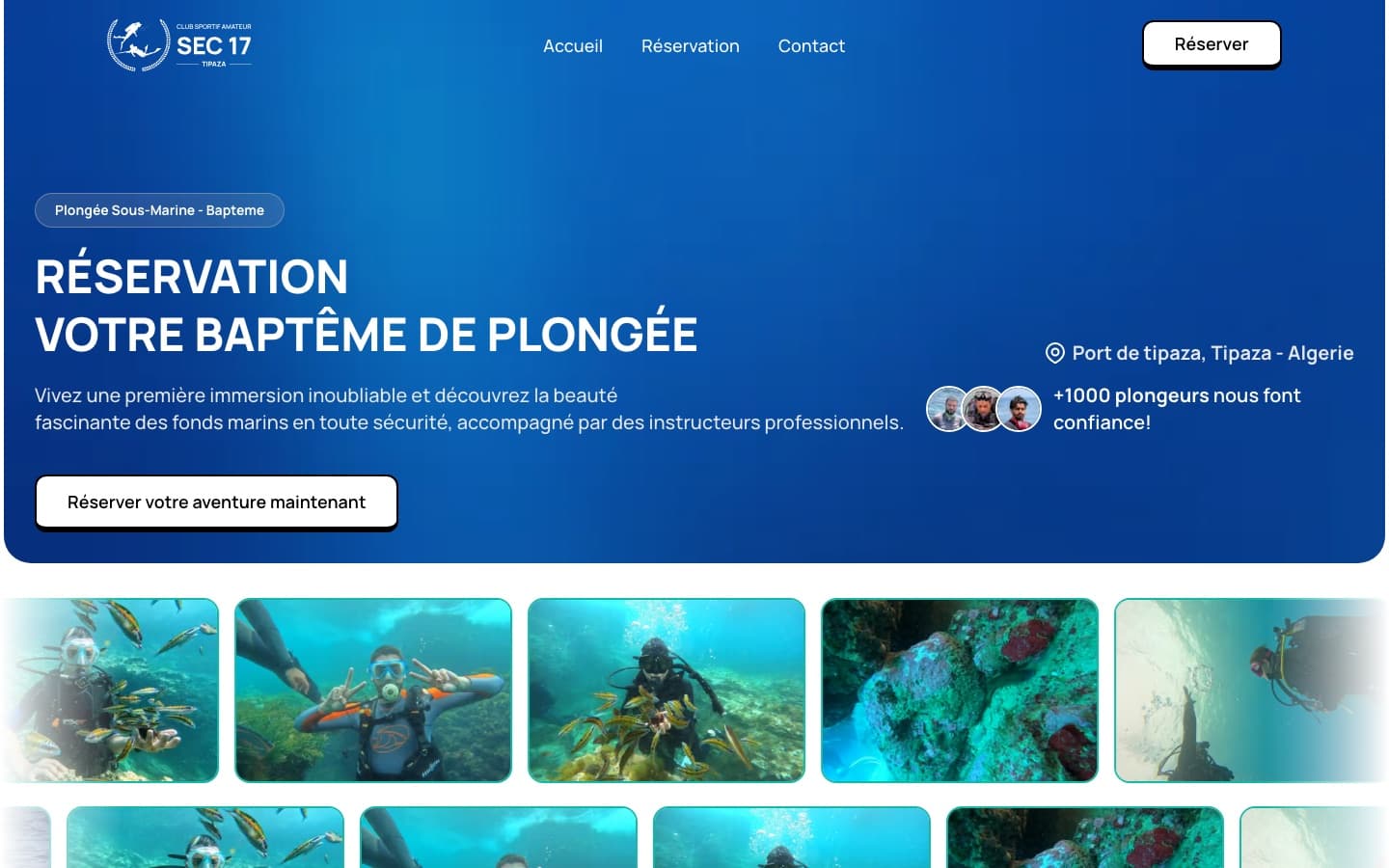
Club SEC 17 has taught people to dive off Port de Tipaza since 1974. Its reputation arrived long before its infrastructure did: every reservation, every availability check and every follow-up ran through two personal phone numbers. We built the operating layer that reputation deserved — a self-service booking flow with real capacity behind it, a staff dashboard that replaced memory with a shared record, QR-verifiable certificates, and a consent-tracked photo delivery pipeline. It ships on Next.js, loads its largest element in under half a second, and the club runs it without us.
The brief.
The club's market is French-speaking leisure divers and tourists around Tipaza and Algiers, most of them arriving on a phone from Instagram or word of mouth, booking a first baptême or a P1–P3 certification. The constraint that shaped every decision: this is a cash market with no online payment, so the site's job is not to take money — it is to hold an accurate, confirmable place in a real diary.
Where it started.
There was no digital operations layer at all. Reservations, capacity and follow-up lived across two WhatsApp and phone numbers. Nobody had a shared view of which dates were already full, so on any day two staff members answered messages at once, double-booking was a live risk. Past divers existed only as chat history. Certificates and dive photos were handed over ad hoc. And there was no way to see how anyone had found the club, so every marketing decision was a guess.
Client-reportedC- Two personal phone numbers as the entire booking system
- Capacity tracked by memory, cross-checked by scrolling chat history
- No structured record of past divers to re-engage
- Certificates unverifiable once out of the club's hands
- No analytics — no answer to “where do bookings come from?”
The before state is described from the club's own account of how it worked in March 2025. No archived version of this domain exists from before the engagement, so none of it is presented as something we measured.
What it had to achieve.
- 01Move discovery-dive reservations off phone-and-WhatsApp onto a self-service flow the diver completes alone.
- 02Give staff one place to see and manage capacity instead of reconstructing it from chat threads.
- 03Make a certificate checkable by a third party without the club being in the loop.
- 04Put a measurement layer in place so the next decisions are read rather than guessed.
What we built.
Five pieces. Each one replaces something the club was doing by hand, and each one is named by what it took off their plate.
Self-service booking with real capacity behind it
The booking route carries per-date capacity limits and detects an existing upcoming reservation on the same phone number, so what a diver sees is the real diary rather than an optimistic form that someone has to reconcile later.
Duplicate detection keys on the phone number rather than an account, because this audience will not create one — the flow has to work for a first-time visitor who arrived from Instagram ninety seconds ago.
A WhatsApp thread where staff checked availability by memory, and a double-booking risk any time two people answered at once.
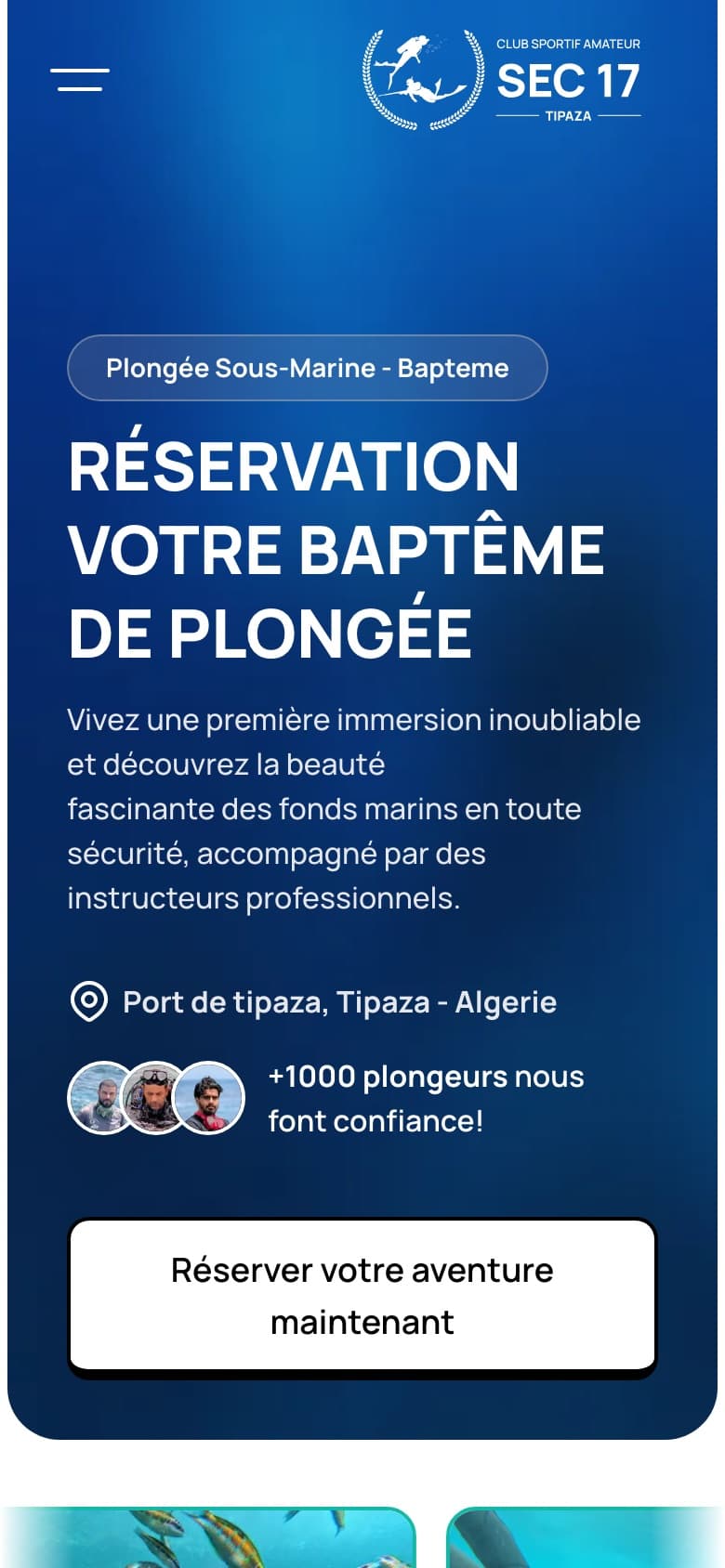
An admin dashboard that replaced staff memory
Seven areas — reservations, availability, photos, certificates, messages and users — behind one sign-in. The overview answers the two questions that decide a dive day before it starts: how many divers are coming, and who still has to be phoned. Capacity for the next nine days is drawn as one chart, with sea-closed days hatched straight into it, so a date that looks bookable but isn't reads as closed without opening anything.
The system didn't abolish the phone call — it scheduled it. Confirmation still happens by phone the day before, because that is how the club actually runs; the dashboard's job is to make sure nobody is missed, and to count the attempts when someone doesn't pick up.
Capacity that existed only in the heads of the two people answering the phones.

Certificates that verify themselves
Certificates are generated automatically and carry a QR code pointing at a public verification route, so a dive centre or an employer anywhere can confirm a credential without contacting the club.
Ad hoc documents that nobody outside Tipaza could check.

Watermarked photo delivery, with consent on the record
Dive photos are watermarked and delivered through a token-scoped link, with an explicit consent step recorded per recipient before anything is shared.
Photos sent by hand over WhatsApp and Instagram, with no record of who agreed to what.
Every delivery link is scoped to one recipient and one set of photographs. There is no public URL to screenshot, and manufacturing one would misrepresent how the pipeline works.
The measurement layer
Google Analytics 4 and Microsoft Clarity both run on the live site — counted events alongside session recordings and heatmaps, so the club can see not just how many people reached the booking screen but where they hesitated on it.
No analytics of any kind, and therefore no way to tell a good decision from a lucky one.
The numbers.
Taken from the live site by our own capture run, on real Chromium, on the date at the foot of this page. Every row carries the method that produced it.
| Metric | Measured | Benchmark |
|---|---|---|
| Largest Contentful Paint — desktop | 0.49 sM | Good < 2.5 s |
| Largest Contentful Paint — mobile | 0.52 sM | Good < 2.5 s |
| Cumulative Layout Shift | 0.001M | Good < 0.1 |
| Time to first byte | 197 msM | Good < 800 ms |
| Page weight | 520 KBM | Median site ≈ 2.5 MB |
| Images served through an optimising pipeline | 67 of 69M | |
| Structured-data types published | 10M | |
| Security headers | HSTS + CSPM |
How each number was obtained
- Largest Contentful Paint — desktop
- Headless Chromium at 1440×900, PerformanceObserver on the live site.
- Largest Contentful Paint — mobile
- Headless Chromium at 390×844 on a 2× device pixel ratio — the device class most of this audience arrives on.
- Cumulative Layout Shift
- Accumulated over the full load, excluding shifts that follow user input.
- Time to first byte
- Navigation timing, served from Vercel's edge.
- Page weight
- Sum of transferred bytes across 59 requests on the home page.
- Images served through an optimising pipeline
- Counted from rendered image sources; 67 also carry responsive srcset and lazy loading.
- Structured-data types published
- JSON-LD @type values across the crawled pages: SportsActivityLocation, Reservation, ReserveAction, Offer, Service, Review, Person, PostalAddress, AdministrativeArea, EntryPoint.
- Security headers
- Present on the live response, alongside HTTPS across the whole domain.
Before → After.
Seven capabilities, as the club described them in March 2025 and as they stand on the live site today.
Taking a booking
BeforeCPhone and WhatsApp, manually cross-checked
AfterSelf-service form with real capacity behind it
Knowing a date is full
BeforeCStaff memory and chat history
AfterPer-date limits enforced at submission
Double-booking risk
BeforeCLive whenever two people answered at once
AfterDuplicate detection on the phone number
Record of past divers
BeforeCWhatsApp scrollback
AfterStructured reservations in a staff dashboard
Certificates
BeforeCAd hoc, unverifiable outside the club
AfterGenerated with a QR code and a public verification route
Photo delivery
BeforeCManual sends, no consent record
AfterWatermarked, token-scoped, consent recorded
Behavioural analytics
BeforeCNone
AfterGA4 and Microsoft Clarity live
Every entry in the before column is the club's own account, not something we measured — no archived version of this domain exists from that period. Every entry in the after column is observable on the live site today.
Craft details.
Built for a thumb, not a desk
The audience arrives on a phone from Instagram. The mobile build ships 40 requests, has no horizontal overflow, and holds layout shift at zero while it loads.
Machine-readable, not just readable
Ten JSON-LD types including Reservation, Offer and ReserveAction mean a search engine can present the club as a bookable business rather than a page about diving.
Fast because of what is not there
520 KB across the whole home page, against a web median near 2.5 MB — with 67 of 69 images going through an optimising pipeline with responsive sources and lazy loading.
French-first, properly declared
The document declares its language, which is what lets a screen reader pronounce it and a search engine target it — a detail that is invisible until it is missing.
Plonger fi SEC 17 kanet une aventure inoubliable! L'eau kanet cristalline ou les guides kanou yaarfou chaque détail du site.Where it stands.
- The club takes reservations without a person mediating every one of them.
- Capacity is enforced by the system rather than remembered by staff.
- A certificate issued in Tipaza can be checked from anywhere.
- Two measurement tools are live, so the next round of decisions has data underneath it.
Conversion and booking-volume deltas are deliberately absent from this document. They need a tracked baseline running over a full season, and that data does not exist yet. When it does, it goes here as a measured number — not as an estimate.
What's next.
The engagement is ongoing. These are the three things in front of it.
- 01Define the conversion events in GA4 so booking starts, completions and abandonment are counted rather than inferred.
- 02Read a full season of Clarity recordings against the booking screen and cut whatever causes hesitation.
- 03Add alt text to the remaining gallery images — 45 of 69 currently ship without it.
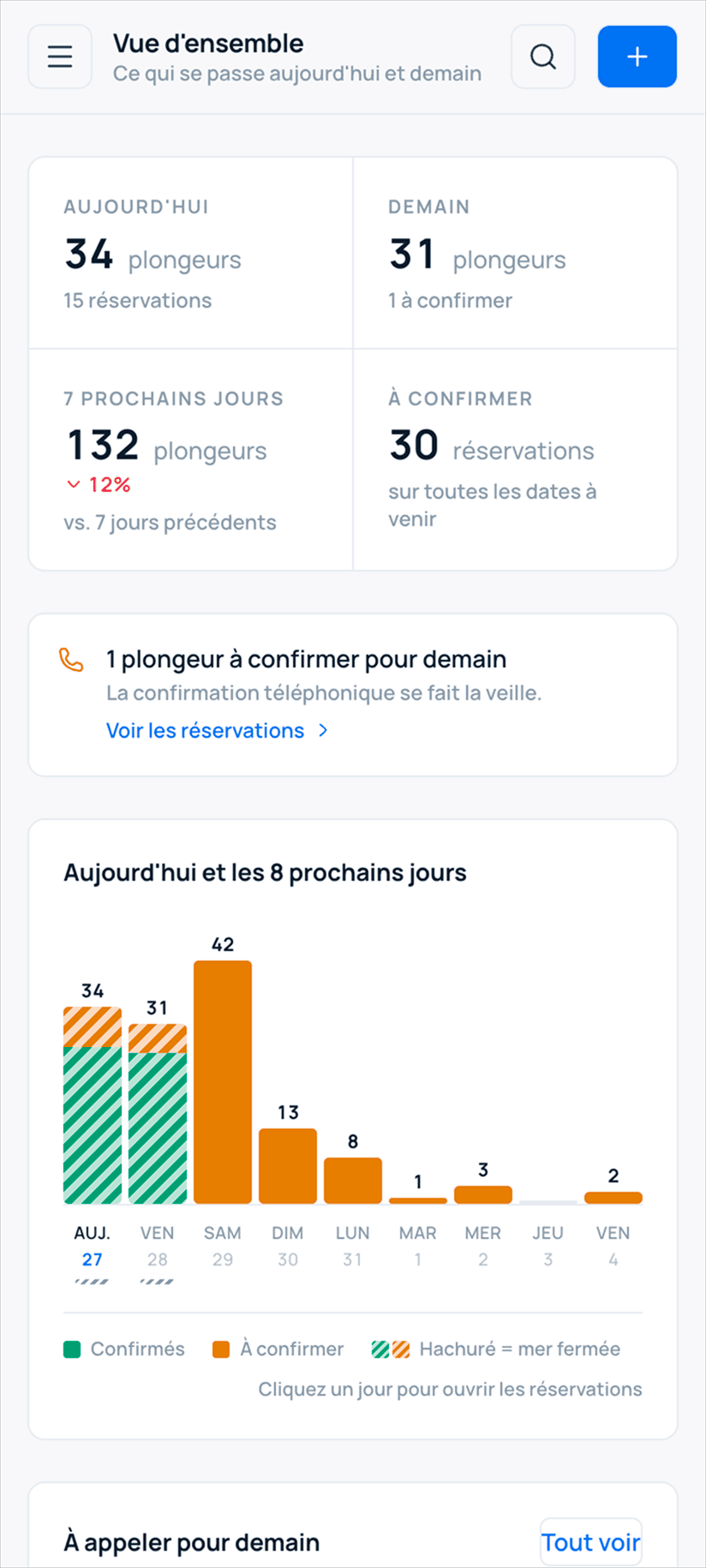
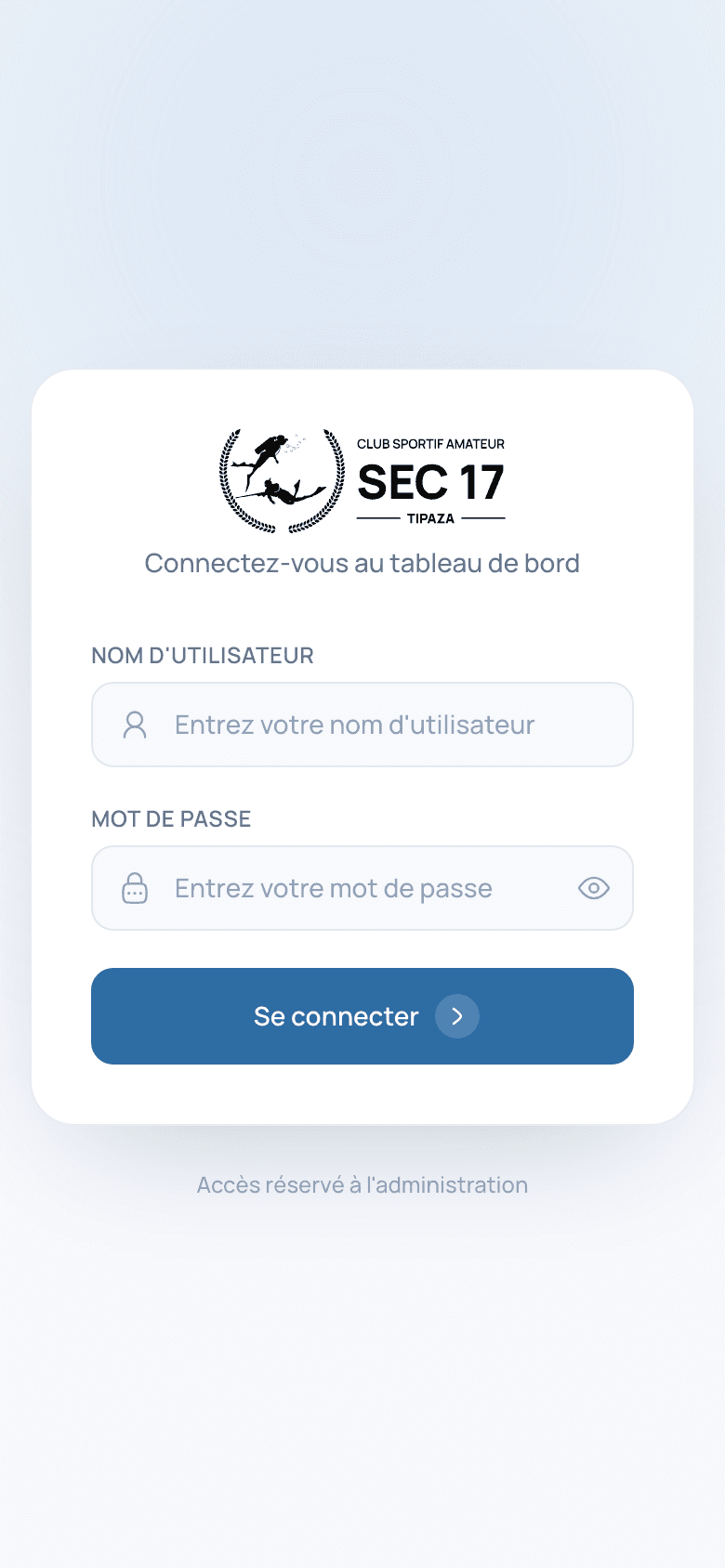
The same system, on a phone.

About this document
- M
- Measured — Taken from the live site by our own capture run, on real Chromium.
- C
- Client-reported — Supplied by the client from their own records. We did not observe it.
- Live measurements taken 27 August 2026.
- Captured with headless Chromium at 390×844 (mobile) and 1440×900 (desktop), motion disabled. The staff dashboard was captured separately, from an authenticated session, at the resolution it is worked at.
- The capture run was read-only: only GET requests were issued, form submission was disabled in the page, and no data was created, changed or deleted on the client's system.
- Personal data is kept out of these screenshots two ways. On the public pages it was replaced with placeholders in the page before the capture. On the staff dashboard one diver's contact details were painted out of the image afterwards, and the shot says so where it appears. The layout and the behaviour shown are real; the personal details are not.
- Nothing here is composited, recoloured or rearranged. The only edits to any image are those redaction blocks and one crop to its subject.
- Measurements describe the live site on the capture date and will drift as the site changes.
That's one of four. The rest are on the way back.